Economic definitions that annoy me, Part 1: Tell me again, what is left wing and what is right wing?
Everyone has pet peeves. For some, it is when someone does not understand basic geography, like where the Midwest in the United States is located. For others, it is misusing words like supposebly for supposedly. When it comes to economics, I have several pet peeves that drive me crazy since these misconceptions can make it impossible for us to communicate and debate each other effectively.
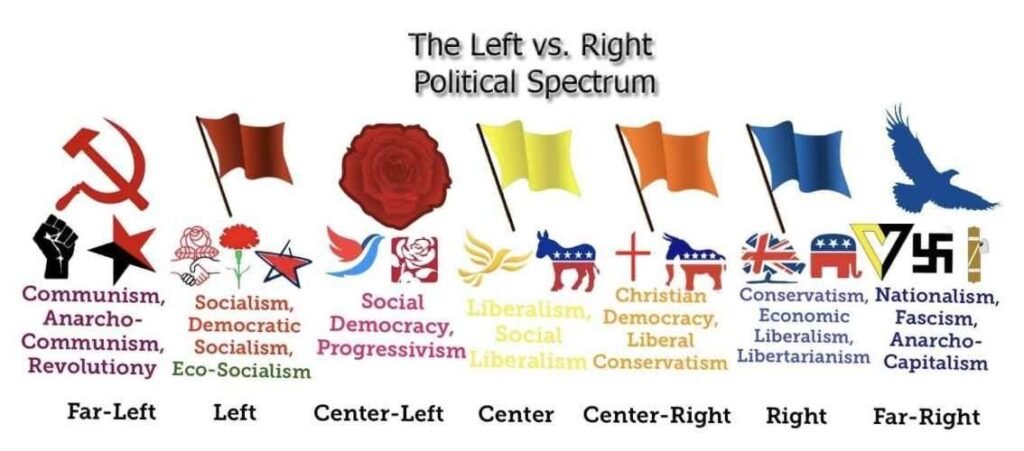
I have a good friend, Bob. I have known him for over 20 years and I respect him deeply. He is intelligent, has a good heart and is well educated. We had a conversation a while back and I was trying to explain how I see politics by defining what I thought the right-wing, left-wing continuum looks like.
Bob was having none of it. He was stuck in two areas. First, he could not grasp that there may be radically different ways of defining these concepts from his own approach. But, more importantly, it became clear to me that while claiming my model was invalid, he had no working definitions of right and left wing with which he could reinforce his arguments. He was sure he was right and I was wrong, but he had no model at all, just a belief. This is a common problem in politics and economics. It is easier to say that you believe something is incorrect than it is to provide an alternative model. For 45 minutes we went back and forth until I finally convinced him to stop arguing until he understood my model and where it leads to if you accept it. Ultimately, he may not have agreed with my model, but he could at least understand it and see that it was mostly internally consistent.
In the descriptions below, I deliberately try not to use emotional words when describing each political movement, since all I am attempting in this blog is to define a model in which to view the various political/economic movements. I know this will annoy those of you who want to go right to what’s “right and wrong”, but I take you back to earlier blog where I discussed positive and normative economics. As a reminder, positive economics is the science about how scarce resources get allocated while normative economics is about our opinions on what “should” happen. This blog is meant to use the phraseology of positive economics, while waiting for future blogs to discuss what is right and wrong about each of these movements, in my opinion.
Different models of Left- and Right-Wing Ideologies
One way to differentiate between right-wing and left-wing ideologies is by looking at social issues. Do you believe in gun control or drug enforcement? Do you believe in abortion or pro-life positions? Do you believe in significant immigration or limited immigration? This means that of the nearly infinite number of policy issues out there, that somehow there are a few that clearly define what is right and left. I do not believe in that model.
Another way to look at this concept is through government spending and regulation. The problem here is that depending on the specific issue, you may be in favor of more or less regulation or spending. Liberals may want more welfare spending while conservatives may want more military spending. Liberals may want fewer restrictions on abortion while conservatives may want fewer restrictions on the right to own guns.
In both examples above, to bucket each ideology, you have to look at a specific issue which makes creating a generalized model nearly (but not completely) impossible.
Gary’s model of competing political ideologies
My model utilizes a lot of work that others have done in this area, and it tweaks these models just a bit to get a somewhat unique perspective on the subject. It is precisely the conclusions that you reach if you use my model that will make both liberals and conservatives uncomfortable, since the results challenge each side’s worldview (and more importantly, their view of themselves, in my opinion). Most people do not like their worldview challenged and I find they often resort to name calling and anger when that happens.
This model is meant to be a generalized model that uses only one basic concept: The concentration of government control over its citizens’ lives.
Now half of the readers out there are probably saying, well duh, of course that’s true and half of you are saying there is no way you can differentiate virtually every ideology with such a simple definition.
But hold on there for a moment because I think this simple concept of right and left leads to some conclusions that will surprise many of you (I know it led me to places I could not imagine).
So, let’s start with the extremes and make you uncomfortable really fast. If you say that the left is ok with more government control and the right is ok with less government control, then the opposite end of the spectrum cannot be Communism and Fascism.
Instead, I would argue that the lack of any government control and no concentration of power in the government would be anarchy. Miriam-Webster’s first definition of anarchy is “a state of lawlessness or political disorder due to the absence of governmental authority.”
I would argue that no government at all means that government control and its concentration of power is zero. Think of any dystopian movie about the future after a major disaster or nuclear war and you get the idea. That puts anarchy on the far right of government control and power. I have just made my conservative friends nervous and somewhat unhappy. Hold on my liberal friends, I am coming for you soon.
What is on the opposite end of anarchy? Complete government control concentrated in one person’s hands. This model was used often during the Middle Ages when Kings or Queens ruled their lands. Today’s best example is probably North Korea. Power is totally concentrated in one person’s hands in the government.
So, let’s move along the continuum and see where the model ultimately leads us. But realize that there is no such thing as a pure political ideology. In virtually all cases that I discuss, individuals have beliefs that overlap with multiple ideologies, which is why I view this model as a continuum.
To the left of anarchy is Libertarianism. Libertarians believe that liberty is the PRIMARY political asset, but not the only one. Libertarians usually believe private property, laws that govern free speech and freedom to worship, and equal treatment under the law are critical. There is a role for government to protect these and other rights of the individual. If Libertarians’ freedom does impinge on others, then that would be considered a legal problem by Libertarians. But causing mental discomfort to someone else because of Libertarians’ actions or views is not sufficient to use the government’s power to stop them from enjoying their rights, in their view.
To the left of Libertarianism is Conservatism. In many books and articles, conservatism means maintaining the status quo. But I think this simplistic definition is completely wrong. Would modern conservatives like to keep the current level of Federal Government spending? Would conservatives like to keep progressive tax laws in places like California and New York? Did conservatives want to preserve the Title IX changes regarding trans athletes that Biden put in place? I think not, so that keeping the status quo is not a good way to frame conservatives. My definition is that conservatives want limited government spending and regulation in areas that are not considered government responsibilities in the US Constitution, whereas Libertarians do not want the government involved at all in areas not mentioned in the Constitution.
Let’s skip talking about the center (or what some people call Moderates) for now, because I will discuss that in detail at the end of this blog.
On the left side of the center of the spectrum are Liberals. They truly believe that the government can be an instrument for positive change. They are less concerned about what the Constitution says are the responsibilities of Government but believe that the Constitution should reflect current views. Progressives on the other believe that Government must be used to make positive changes in society according to their views of positive change. Progressives often believe the only way to make some positive changes is through the government.
Socialists are to the left of progressives. They believe that the means of production and distribution must be owned by a centralized government that does the planning and executing of the economy. In this worldview, things you own personally are ok to an extent, but you should not be using private property to create or build wealth, since that belongs to everyone. In many socialist contexts, other political parties are allowed.
Communists on the other hand do not believe in private property but believe that all resources should be based upon need, determined by the government. In most communist contexts, only the communist party is allowed to exist since it is the one that decides how resources are allocated.
This leaves us with two groups that will probably provide the greatest angst to many of my readers: Fascists and Moderates.
Let’s start with Fascists and the commonly used descriptions of them. Fascists are normally considered right wing for a couple of reasons. First, they were the enemies of Communism, so people assume they hold opposite beliefs. A google search gave the following answer:
“Fascism is considered right wing because it emphasizes nationalism, authoritarianism, the subordination of individual interest to the state as well as the superiority of certain individuals.”
Let’s parse through each one of those. Do states that are more aligned with nationalism lean right? China, and Russia often exhibit nationalist views and yet we do not consider them far right. Authoritarianism, which means absolute obedience to authority, fits much more with the left side of my model than the right. It is certainly on the opposite side of anarchy in my model. Saying that the superiority of certain individuals is a right-wing phenomenon is mere opinion and not backed up by many historical facts.
No, in my model, Fascism and Communism were competitors, and not opposites. Both believed in the state as ultimate authority; both believed that individual liberty should be limited; both believed that the means of production and distribution should be controlled by the state. Now, some will say, but Fascists leveraged individual industry and let private companies make profits when working for the state. Has anyone ever heard of Russian oil oligarchs or Chinese Tech moguls?
Finally, the greatest example of fascism was the Nazi Party which was short for Nationalsozialistische Duetsch Arbeiterparte. This was another name for the National Socialist German Worker’s Party. At its whim, the Nazi’s sent millions of people to their deaths. So did Mao and Stalin. Both of those philosophies viewed the state as the only entity capable of deciding who lived and who died. In modern times, some individual leaders have made their own interpretation of who should live or die, and there is no doubt they go across the entire continuum I have created. But none of these fit any neat political/economic model.
No individual liberty: all means of production decided by the state; allowing only those who you favor to make and earn profits; choosing who lives and who dies.
I would argue that the reason Fascists and Communists disliked each other so much was not that they were on the opposite sides of the political/economic spectrum, but because there was only room for one of them to own the means of production and make the decisions.
In my model, Fascism and Communism are on the far left of the political spectrum.
The only movements even further to the left of Fascism and Communism are monarchies/dictatorships due to the concentration of power in the state in one person’s hands. Over the millennia, kings/queens and dictators had ultimate authority over their lands and could literally decide anything they wanted at any time they wanted. Some ruled ruthlessly while others were more benevolent. But it was up to the king or queen to decide how they ruled. Henry VI (England), Julius Caesar (Roman Empire), Khufu (Egyptian Pharaoh), Genghis Khan (Mongol Empire), Haile Selassie 1 (Ethiopia) and Adolph Hitler are just a couple of examples.
In today’s age, Kim Jong Un of the Democratic People’s Republic of Korea (North Korea) is the closest we have to an absolute king, although he is also the leader of the Workers’ Party of Korea and holds himself up as a Communist. In Figure 1 below, I present the continuum model based upon government power and control.
Conclusion: There are many models for defining right and left wing political and economic views. I present one here based upon the desired level of government control over people’s lives by the political ideology. It is not perfect, but I believe it is a good model for discussing political and economic viewpoints.