
Like most people, I had no training when I became a supervisor for the first time. One day, I was an individual contributor working on my projects at Blue Cross and Blue Shield of Michigan and the next day I oversaw other employees.

Just like that. And like most people, I made my share of mistakes. I under communicated, over communicated, communicated badly and then thought that others did not do what I asked because they “failed” to understand me. I assigned too many projects to some and not enough to others. None of this was done from ill intent but was the result of just learning to be a leader on the fly. After several missteps, I slowly started to get a little better. I did this through three separate steps.
Step 1: Introspection
At first, the mistakes that were obvious to me revolved around communication. I can sometimes talk too quickly and assume that the person I am talking with totally understands what I am saying every time. If I asked them if they understood, they would politely nod or say yes without really getting the gist of what I wanted done. So, in the car, I assumed that every missed opportunity for communicating effectively was my fault and not due to some inadequacy on the listener’s part. I started asking my team to tell me in their own words what each assignment entailed, what the expectations and timelines were and how they would communicate progress. Things improved quickly.
As a result, I started doing this with all aspects of my job, including how to coach and mentor my team and how to interact with peers and other leaders. I also thought about how I led meetings and what could improve there. Over time, I hit every important topic. When you assume that 95% of the time the failure to adequately execute is your fault, it can be quite humbling. But it does make you a better leader.

Step 2: Shadowing and questioning good leaders

Step 2 entailed searching out people at all levels who appeared to be good leaders and asking them lots of questions. I found three or four people in our company who were willing to talk with me on a periodic basis about their style and approach. Some let me attend their meetings or staff interactions as an observer. By watching a good leader in action, you can pick those traits that you want to cultivate as part of your own style.
Step 3: Mirror Image Profiling (or doing the opposite of what poor leaders do)
The rest of today’s blog will be devoted to this section, which to me was the most important aspect in helping me dramatically shorten my learning curve. The other day I was shaving. We have a tv in the bathroom and as I was looking in the mirror to shave, the tv was directly behind me. I had a golf tournament on the tv.
If you look in the mirror, while watching a right-handed golfer hit a ball on a tv behind you, the golfer appears to be hitting the shot left-handed. Mirrors give the illusion of flipping things horizontally and not vertically (although that’s not how the science around it explains it but that’s not for this blog). This reminded me of the third way I learned leadership skills, by watching what bad leaders do and then doing just the opposite!

We have all experienced bad leadership. A few years ago, I listed all of the leaders I reported to or had significant interactions with them on a routine basis. It turns out that roughly 20% of them were great, 40% of them were really bad and 40% of them had many good traits but a few bad ones as well). Even the very best had some things they personally worked on their entire lives so that they could constantly improve. I am going to go through several profiles of leaders who made severe mistakes but never understood that they were doing anything harmful. Their names have been changed to protect the guilty, but mainly to reduce the chances of them doing anything destructive (that’s partially tongue-in-cheek). But every single story is true although it is obviously from my perspective. You will probably recognize the traits of many of these leaders from your own career.
Communications
Complete lack of communication

Early on in my career, I reported to a manager who had extreme difficulty in communicating with her staff. Let’s call her Barbara. Barbara was very bright and well educated. I never asked her directly, but my opinion was that she did not like communicating with anyone who she felt was less intelligent than she was, which in her mind was 99% of the world’s population. We had about 15 people in our department.
Over time, each one of the employees did something to annoy Barbara and as a result she would stop talking directly to them. I was a supervisor over a few of Barbara’s staff but not the majority. Over time, I noticed that Barbara would ask me to give assignments and get updates from employees who reported to other supervisors in the area. Eventually, she stopped talking to all of her supervisors and employees and just went through me to get updates and give assignments.
You can probably guess what this did for morale in the area, not to mention how ineffective this process was. After about a year, I was asked to take a promotion in a different area. I have no idea how assignments or updates occurred in that area after that.
What did I learn? As a leader, you must be able to communicate with all levels of your team.
How did I turn that into action? As a supervisor, I met with all staff at least once a week. Even when I later became a CEO, I made it a point to meet with every single supervisor in person (in one job this ran into the dozens of supervisors and above) every single quarter. You cannot understand what is working (or not) or create a culture you envision unless you do your best to communicate with every member of the management staff personally. I also did lunches once a month where staff members were selected at random (without their supervisors) so that I could have casual conversations at lunch where they could ask any questions they would like. This made their supervisors very nervous and many in my management team thought it was a waste of my time, but I found this was the best way to know what their true concerns were.
Overcommunicating at the wrong time

As I mentioned in an earlier blog, at Amerigroup (a for-profit Medicaid health insurance company) we had some severe growing pains that resulted from improper forecasting of call volumes. My team and I laid out a plan for both fixing the problem and communicating what we were doing to improve the situation in weekly reports. But the immediate problem, for a six-week period, would not get markedly better. The seven CEOs that we supported all agreed to the plan.
But, in the heat of the moment during the first week of the disaster, my boss barged into my office and started screaming at me that more had to be done (we were all working 14-hour days to do what was humanely possible). He demanded that we change the communication process from an update on Fridays to an email written by me every 15 minutes with how the situation had improved. But the situation was not going to improve until we recruited and hired some added temporary help. For one of the few times in my career, I disobeyed a direct order and told him that we could talk about revising our approach but that my note every 15 minutes for the next few weeks would be “Nothing has changed.”
Well, he threatened to fire me on the spot and I said go ahead, but then who is going to implement the plan to improve operations? He stormed out of my office. We stuck to the plan and beat our projected improvement timelines by one week.
What did I learn? Communication is critical when there is problem but wasting CEO’s time with 30-40 emails a week writing that things are the same is probably not a good use of anyone’s time.
How did this incident change my behavior? When fixing a problem, always communicate effectively but do not inundate people with information they already know. Be prepared to adjust your communications strategy but only do it if it will actually help the communications process.
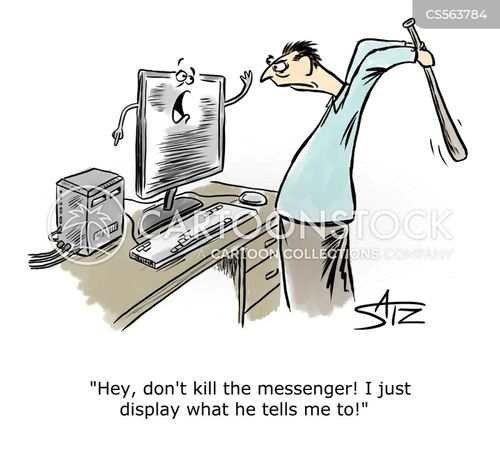
Blaming the messenger for a problem
Back at Blue Cross and Blue Shield of Michigan, I was a low-level manager given the responsibility for providing data to our customers and their vendors when required. We usually resolved these requests easily and within a week. The first problem came from a request from Ford Motor Company through their vendor Medstat. The request asked for lots of data (four years of paid claims data for Ford’s 156,000 U.S. employees and their families) and for something we had never been asked for before (names and addresses on all employees’ claims data with the names and addresses not being encrypted or redacted).
Since I had never done this before, I went to our legal department. We developed a policy that said all names and patient addresses would be encrypted unless the request was specifically signed off by an Executive Vice President or above. This was to make sure that the company rarely provided this data and only would do so with high level approval. It protected both our company and the patients’ identities unless the data was really needed at that level. Legal signed off on the policy. I informed Medstat and Ford of the policy and that I would seek approval from an EVP.
Before I could get the approval, I was called into an Executive team meeting with all EVPs and the CEO of the company on the following Monday. One of EVP’s told me that Ford was a big customer, and I should release the data. I said corporate policy requires me to get EVP approval and asked if he would be willing to sign off on the request. He did not answer the question but just started yelling at me to release the data. I asked if any of the EVPs would sign off and they stayed quiet.
Yes, Ford was a big customer. Yes, we wanted to keep them happy. But if you break policy for one then you break policy for all. These EVPs knew that releasing unredacted data was very risky and the company and whomever did so would be at a high level of legal risk. The EVP said I should be fired for refusing this request. For the second time in my career, I disobeyed a direct order and just asked for one EVP to sign off. No one did. They did not fire me, but I am sure that a few of them were not my biggest fans.
I heard that my director ultimately released the data at his own personal risk. I kept my job and followed policy every time thereafter.
What did I learn? When someone brings a complicated issue to you, don’t blame them for doing so, but collaborate with them to solve the issue at hand.
How did it change my behavior? When my team brought me issues that some people might have thought were not that important, I remembered that day when I was presenting an issue that seemed important and tried to take their concerns very seriously.
A similar issue happened when I was at Anthem (now Elevance), which had just bought Amerigroup where I worked. The transition to the Anthem systems and hardware was going badly. I called the transition lead, an Executive Vice President named Betty. She did not take my call, but her assistant asked me to leave a voice message. I explained the challenges we were having and said I would like to discuss them before our big corporate meeting later that month. She did not return my call. I tried again later that week and followed up with an email requesting a discussion. I escalated to my boss to give him a heads-up. He had no success, either.
At the corporate meeting Betty began the discussion on the merger by saying not a single person had made a complaint about the transition. I could hear several of my peers complaining behind me that they had tried to tell her, but she never returned their calls.
During the Q&A, I did not challenge her statement but went through a lengthy list of issues we were facing. Betty did not look happy. Many of the leaders from Amerigroup did stand up and applaud when I was done. The issues were all resolved by the next month, but it really should not have come to that. Don’t blame the messenger when they have a concern.
Understanding assignments and rewarding work properly

The final story for today involves my first full-time job at Blue Cross Blue Shield of Florida. I was hired into the Actuarial Department because of my background in economics and modeling.
My manager Ali asked me to attend a meeting with our Director, Dipak. Dipak asked me to create ten economic models using different reasonable assumptions so that we could see the effect of each on company revenues, costs and reserves (the money left over for a non-profit health insurer after all costs are subtracted). I had one month to complete this complex project.
After the meeting I told Ali what I had heard and he disagreed. He thought that Dipak wanted me to create one model using the most beneficial assumptions (known as a best-case scenario model) for ten variables. I suggested we go back and check with Dipak, but Ali was sure that he knew what Dipak wanted since he had worked for him for so long.
A meeting was set a week before Dipak was expected to present the report to the Executive team. To say the least he was not happy with what I presented. He took Ali into his office and there was some loud discussion about expectations and what was presented.
Then Dipak brought me into the office alone. He said that I had always delivered before and asked what went wrong. I explained that Ali and I had differing views on what was needed but that I deferred to him because he was my manager. Dipak said in the future I should be more forceful if I believe that I was right. We had one week to create the models he wanted that should take us four weeks normally to do properly. Dipak said, “Can you get this done in time?”
I said, “Yes, sir,” even though I wasn’t sure I could.
So, I spent almost all waking hours creating ten models in one week. On the day before Dipak’s presentation, we shared the results. Dipak was very pleased. It was exactly what he was looking for and was ready to give the presentation.
He looked at Ali and said, “Take Gary out for a very nice dinner to celebrate!”

Ali told me he had plans for the evening but would provide me with something the next day. On my desk waiting for me next morning was an envelope. In it was a $10 Gift Certificate to McDonald’s.
I ran into Dipak a couple of weeks later and he asked me where Ali had taken me for dinner. I explained what had happened. By the end of the month, I had a new manager, and Ali was no longer with the company. It must have been too many issues with his management style that cost him his job.
What did I learn? Always be sure you truly understand the project and timelines you are given. Once email became ubiquitous in the workplace, I always verified important projects given by an executive by sending him or her an email with what I thought was expected and when, while always cc’ing my manager on the note.
How did it change my behavior as a leader? I realized that not all requests are understood by every stakeholder in the same way so when I gave out an assignment, I tried to follow it up with added communication to make sure we were all on the same page.
Also, when someone went the extra mile to fulfill an assignment, I tried hard to make the reward commensurate with the effort needed.
Conclusion:
Often you can become a better leader by doing the opposite of what a poor leader would do in the same situation. We all make mistakes, but bad leaders consistently make the same mistakes repeatedly.