

If you are just starting out in your career, or you are mid-career and trying to distinguish yourself, the first thing you should do is forget 99% of what books and other executives say about leadership. Not only is most advice on leadership incorrect, but it could be dangerous to your career if you follow such advice. Today’s blog will be about the traits and actions that you need to become an effective leader.
I have interviewed literally hundreds of candidates for mid-level and executive positions and have been personally interviewed for dozens of jobs. The question of “Why are you a leader?” comes up often.
The first mistake that most books on the subject make is to identify a set of immutable traits needed from all leaders. I am sure you have seen examples of these traits many times. These traits often include:
- Effective communication
- Follow through
- Transparency
- Integrity
- Results driven
- Vision
- Compassion
- Courage
- Gratitude…
And on and on the lists go. There is nothing wrong with any of these words or similar ones. The problem is they are not leadership, but they are prerequisites for becoming a leader. In other words, they are necessary for becoming a great leader, but they are not sufficient. Besides, how many of us can look someone in the eye and tell them we excel at every single one of these traits? I would argue that only a narcissist would claim to be good at all these traits. For the rest of us mere mortals, who are human and make mistakes every day, all we can hope for is to become better at these over our careers and lifetimes.
But even if I were great at all of these, that would not make me a great leader. I could be courageous and still make awful decisions. I could be compassionate but not be able to make the tough decisions that affect my employees’ lives when they are necessary. I could have a great vision but one that will never work in the marketplace. I could have integrity but also have a fear of failure that prevents me from being effective.
So, yes, strive to get better at each of these traits and others because these traits will make you a better human being, but it will not necessarily make you a great leader.
What are the traits and behaviors of exceptional leaders?
If you have most of traits of being a good person and are doing your best to continue to improve in these areas, what are the additional essential traits and behaviors that will help you to become a great leader?
Intuition and decision-making with partial information
As a CEO, I used to joke (slightly) and say that on any given day, as many as a hundred issues might be brought to me. I would then have to focus on the four that were most important and deal with the one that was the most urgent. While this was an exaggeration to make a point, it was not that far from the truth.
To be an effective leader, you must first have a great understanding of which issues you need to personally deal with and which ones your staff or others should deal with since time is your greatest asset, and you need to use it wisely. It’s best to understand the types of issues you would personally get involved with before they come to you. Major customer complaints, important corporate or regulatory inquiries or large-scale operational disruptions might be all at the top of your list.
If you don’t seriously prioritize your issues in advance, then you will forever be chasing issues and have no time to be involved in growing the business, improving operations, mentoring employees or monitoring the competition.
But often the problem occurs after you become involved with an issue. I found that I never had 100% of the information I wanted in making any decision. Often, you cannot wait until you have all the information you need, but many executives never become the leaders they could be for fear of making a bad decision with limited information. In 90% of the cases, I only had 50-60% of the hoped for information when it became critical to make an important decision.
In those cases, do you ask for more information anyways? How do you know when you have sufficient information?
Unfortunately, this is when intuition and experience are most important. In a future blog, I will discuss this most important aspect of leadership in more detail and give specific examples where a decision was made properly (or not) by myself or other top executives.
Risk neutrality and a lack of fear of failure
The risk profile of a leader can be a determining factor in long-term success. Risk lovers are people who like to take risks just for the sake of taking them. They get as much or usually more satisfaction in taking a risk than in the actual result!
I was once sitting at a poker table several years ago with two high flying gamblers. A Los Angeles Lakers game came on the tv near our table. One turned to the other and said, “Usual bet?”
“Sure”, came the response.
So of course, I had to ask, “What’s the usual bet?”
“$50,000.”
This is an example of Risk Loving behavior. $50,000 for one game. This is not the successful behavior of most leaders.
On the other hand, there are highly risk averse leaders. This means even if the odds are highly in their favor, they will not take a chance. I have a friend, let’s call her Olivia. I once offered her a bet on a Super Bowl game for $1 where I would let her pick the winner AND I would even give her the dollar. She refused. That is extreme risk aversion and is not a trait you want in a leader, either.
Most people in the world are slightly risk averse. They will take a risk, but they must be compensated with significant returns. Being a slightly risk adverse leader is not the worst thing, but it does mean you will pass up very good opportunities over the fear of failure.
Leaders who often sleep the best and make great decisions using intuition with partial information are risk neutral. This means that the odds of success and the rewards that follow are sufficient to compensate them for the risk without a larger risk premium. The easiest example is if I offer you 1:1 odds on whether a coin flip will be heads or tails. These are fair odds.
The downside of risk neutral leaders is that they will tend to take more risk than most other people could tolerate. They need to be good decision makers who do not put the company or themselves at unnecessary risk (like if I offered a $1,000,000 bet on a coin flip).
Risk aversion by a leader can clearly change based upon the size of the loss/gain and whether you are using company funds or your own (like buying a risky asset for the company where there is no harm to you). Generally, risk neutral leaders who can deal with uncertainty sleep better and make more objective gain/loss estimates.
Fear of failure has been the demise of many a promising career. I embraced failure during my career since 90% of what I learned was from the mistakes I or others made. In many job interviews, I was asked if I could recall a mistake I made. This question is designed to show that you are self-aware enough to know that you make mistakes and to provide examples of how you grew as a result. My response was consistent and not tongue-in-cheek, and I meant it when I said, “which day would you like discuss?” By embracing the failures, I could explain what I learned and how it made me better.
Continuous Learning
Effective leadership requires an inquisitive mind and a desire to learn continuously. I am a strong proponent of continuous learning and attribute much of my career success to it.
In 1919 (yes, this was even way before my time), a cartoon character called Felix the Cat was first shown in theatres. Felix got into all kinds of mischief, but he was always the winner in the end due to his extraordinary bag of tricks. He could literally turn his little bag of tricks into a table, or a saw or a hammer or anything he needed to solve the problem at hand.

Early on in my career, I decided that no matter what job I was in, I would use that job to add to my skill sets (or my bag of tricks). So, after my first job, I looked to see if there was a chance I would learn a new skill in my next job and I would not consider taking it, even if it was a promotion, unless I thought it was possible.
Even in my first job, I learned one of my most valuable lessons as a future leader. At 17, I was the maintenance person at an Arby’s restaurant in the Detroit area. My job consisted of cutting the lawn, keeping the parking lot clean, cleaning out the equipment for milkshakes and cleaning the bathrooms.
Most people do not believe me when I say I learned my most important lessons as a leader cleaning the bathrooms. But it is so true even though I was the lowest paid person working at that site.
I learned that even the lowest level jobs have dignity and that if I did not do my job properly, the Health Department could shut our whole site down. That’s how I got my job. The person before me did not do his job and the Health Department stopped allowing us to sell milk shakes, which were one of our highest margin items, until we fixed a problem with an adverse bacteria count from ineffective cleaning.
In every job after that, I tried to see what I would learn and add that to not only my resume, but my actual ability to be a better employee and leader. As a result, even in jobs I ultimately left after short stays, I still added to my bag of tricks. Then, when I became CEO, I was able to lean on all these skills to make the job much more manageable.
Negotiation Skills
Every four years, in the United States, we go through the ritual of Presidential or Vice-presidential debates. Two or more men or women sit or stand while pretending to answer policy questions while really trying hard to not make the one big gaffe that will be shown on every media site for weeks.
Many voters use these debates as a guide for whom to vote for in the next election. This is just plain silly. Presidents or executives for that matter spend less than 5-10% debating others. What they do spend a lot of hours on, sometimes over 40-50% during certain times, is negotiation. Executives negotiate with vendors, with customers, with regulators, with unions and even with other areas of the company. Presidents negotiate with Congress, with other countries, with the UN and even with their own staff on occasion.
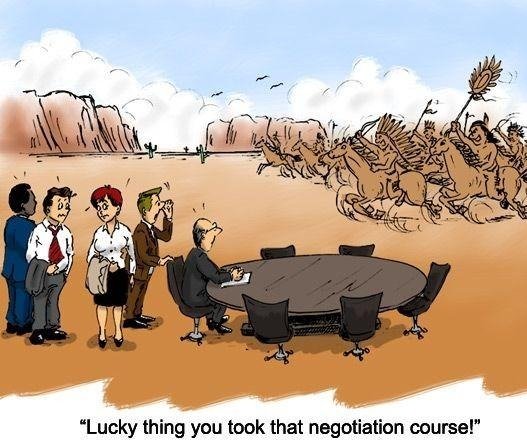
To be a great leader means being a great negotiator. Negotiation can be described quite simply. Negotiation is the act of two or more parties trying to get the most they can from someone else for the least cost. If you have ever been to a foreign country as a tourist talking to a street vendor, you truly understand the art of negotiation.
Let’s go back to elementary school and use Venn Diagrams to describe typical negotiations. In the graph below we have a customer who wants to outsource a project to a vendor.
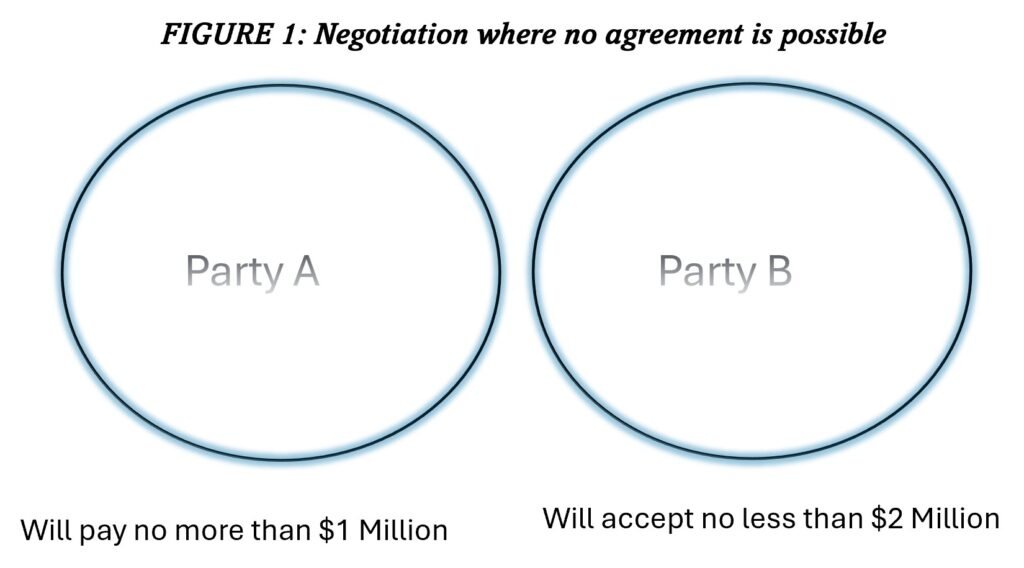
The customer (Party A) is not willing to pay anything more than $1 million for the project. The vendor (Party B) is not willing to do the project for less than $2 million. In this case, this is a no win-win scenario that will not result in a successful negotiation. You could negotiate for weeks and months, to no avail. If both the customer and vendor have equal leverage, it is best to walk away from this negotiation because it is useless, unless you can find an alternative to money for the negotiation (other assets, long-term relationship, customer support, etc.).
But let’s assume that the customer (Party A) is willing to pay up to $3 million instead. Then the graph becomes…
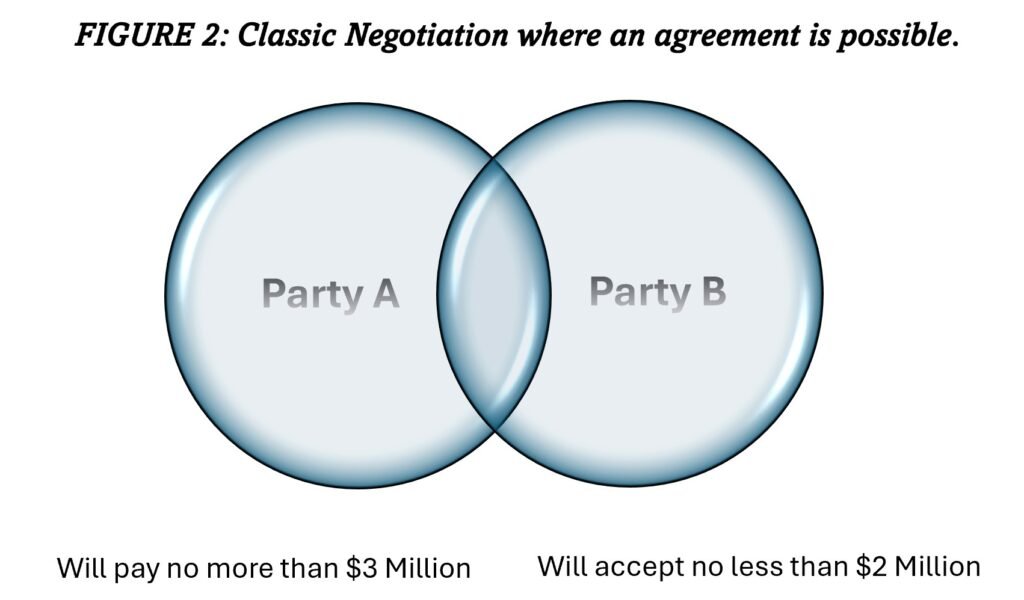
Now it becomes a negotiation. Each party will try to extract as much value as possible from the other. A win-win is possible with both parties accepting less than or equal to what they desire but at least enough for them to make a deal.
The problem of course is that at the start of the negotiation, you have no idea which of the infinite number of graphs is in play. A good negotiator seeks out information that will give insight into where an overlap occurs, if at all.
A great negotiator has a good feeling before the negotiation about where it will end up. A good leader also does not try to extract all the value in every negotiation, since having a good working relationship may provide greater long-term benefits. There will be a future blog on various techniques that can be used to optimize this process.
Semi-permeable skin (Emotional Osmosis)
Some people have thick skin. These leaders react to every criticism by totally ignoring the criticism or responding back harshly. Others try to please everyone and believe that every criticism is important and should be acted upon.
I believe that great leaders should have a semi-permeable skin. This means that they listen to every criticism, objectively evaluate the criticism no matter the source, and act on those criticisms that merit further attention. This is much more difficult than it sounds.
In one job at Ford Motor Company, I reported directly to one person but had two dotted-line bosses. A dotted-line boss is someone who has direct input into your performance reviews but does not oversee your work on a day-to-day basis. Dotted-line bosses are common on large companies where your responsibilities significantly overlap the needs of multiple departments. In my case, I reported directly into the Medical Department (my direct boss) but had dotted-line bosses in Information Technology and Human Resources. In my first performance review, one of the behavioral areas covered was does the person being reviewed take strong, decisive action?
My dotted-line boss in Germany said that I was too soft in this area and needed to become much more aggressive. My dotted-line boss in HR in the United States said that I was way too aggressive in dealing with issues and needed to tone it down a bit. My direct line boss wrote that based upon the context of the situation; I was almost always appropriately aggressive.
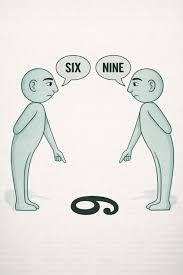
What did I do with that information? I stayed on course with my approach but tried to explain my actions better to my dotted-line bosses. My next review went much smoother in this area. Just because someone believes you are doing something incorrectly, does not mean it is true. But it may still require you to take an action like clarifying your rationale for your actions.
Building high performing teams
There is no one way to build a high performing team. Some executives believe that the only people who can become part of their team are those that have in-depth subject matter expertise. I did not believe that but instead learned through experience that a mixture of complementary talent, some team members with subject knowledge, some with no knowledge, could provide for the diversity of skills sets I wanted.
It is critical if you build teams this way that you select talent that is smart, willing to listen and challenge new and old ways of doing things. Encouraging open discussion, and yes even that concept of debate, is critical for diverse teams to become high performing over time.

Mentoring and having fun

Two traits that are often overlooked are mentoring and having fun. When I was asked what my most important role as a leader was, I always responded the same way. First, is to help all my direct reports who wanted my help to become the leaders they wanted to be by creating a working environment and a relationship with them that allowed for maximum growth. Even today, I talk with 10-12 of my former team members on a regular basis. People need someone who can be direct with them on what skills they need to develop. But they also need someone who will help them get there and understand that they are only human.
Finally, executives spend 8, 10, 12 or more hours every day working. I made it a rule to have fun every single day especially when times were stressful. This could be through self-deprecating humor, providing unexpected treats or just finding a way to inject a little fun into the day. This can be difficult when times are tough, but that is when your teams need to smile a little bit. Knowing when to ease up a bit and have fun is as important as knowing when to hit the throttle and make everyone work a bit harder.
Conclusion
This first blog on leadership is meant to set the table for later, more in-depth discussions on a variety of topics. I have a unique leadership style that is not suited for everyone. However, I think I can offer some ways to help you think proactively about why you choose the way you lead teams, areas or even companies and then decide if you may need to tweak that approach to become even more effective.